Counseling Career and Programs
It’s Everywhere
See people at their worst. Help them be their best. This is counseling in a nutshell. Clients may seek a counselor’s aid with relationships, career, finances, addictions, and loss – basically any area of life that could present a challenge. That would be…all areas.
This means, as a counselor, you can generalize or specialize. As counseling has become more accepted in our society, more and more clients are seeking counselors to navigate difficulties of all kinds. Opportunities exist in various settings, populations, and industries. The Career Outlook section provides an overview of where these are best.
More than Hand Holding
If you have a passion for helping others, good listening skills, and can keep a secret, you are on your way. A career in counseling will require more than this, however. Communication skills, the ability to inspire trust, and working independently or as part of a team are additional talents needed. Energy and strength to cope with an emotionally draining job will also be necessary to remain mentally healthy yourself.
Beyond inherent traits, an education must also be obtained. No matter how many friends’ problems you can fix, you still need the diploma. A master’s degree followed by licensure is the standard. Take a look at the Education Requirements section for the full scoop on training.
What’s The Point?
It’s not the money. As you probably know, helping professions are not high-roller professions. Bet on a salary in the 30K’s. For more specifics, see the Salary Forecast section.
If not the money, then what? This is a chance to make a difference. Studies have shown lives are changed for the better due to counseling. Marriages, debt, substance abuse, grief – individuals and families have found guidance, support, and relief through counseling.
It’s not all pain and healing, either. Counselors can also be found providing career guidance and financial planning. From high school students to mid-lifers changing vocations, counselors assist in decision-making. The goal is choices that won’t lead the client to more counseling later.
Outlook for Counseling Careers
What’s Your Specialty?
Do you have a passion for marriage? Perhaps you really want to help people boost their careers. Or, maybe your desire is to counsel clients through loss. Depending on your area of expertise, the job outlook may differ. Some fields of counseling are expected to see greater growth than others.
Program development, laws, and stigma all affect these numbers. As therapy becomes more acceptable, mental health counselors see more people willing to get help. The “It’s ok, we’re all messed up,” attitude grows. Addiction programs continue to become more prevalent, and are even used as alternatives to jail time, spiking the growth of Substance Abuse counseling.
No Specialty – Ok Too
The overall job growth for the counseling industry is expected to be 18%. Since this is faster than average for an occupation, most areas within the field should be a good bet. General counseling practice is also an option. Clients may see you for whatever life issues they are facing, which may fall under several specialty categories. Just be prepared for anything.
Salaries in Counseling
Warning!
Even with self-provided debt, credit, and career counseling, this job will not likely result in a treasure chest of gold. If you want to go for a swim in cash, see the IT or Engineering sections. Here, what you will find are modest salaries that can pay the bills but not much else. That’s ok, though, because you’re in it for the chance to make a difference, not a buck.
Not that you can’t make more than minimum wage. Salaries vary by industry and experience. As you can see, some school counselors may make more than a few of the teachers in their building.
In general, the highest salaries will be seen by those who are self-employed. The current average salary for this group is $47,000. A well-established practice and a few years of experience can add to this number.
Education Requirements for Careers in Counseling
Learn, License, Listen
Learn – The general rule is a master’s degree. Your studies will cover basic core areas such as:
- • Human development
- • Diversity
- • Relationships
- • Groups
- • Career
- • Counseling Techniques
- • Assessment
- • Research
- • Ethics
Supervised clinical experience will also be required. Some form of internship will provide you with guinea pigs to test your counseling skills.
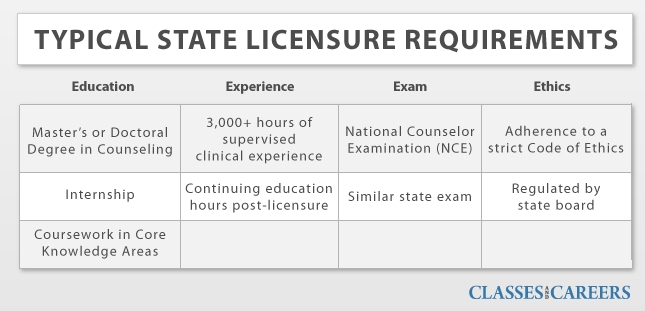
License – This will vary somewhat by state and specialty. However, it is very common for licensure to be required. Currently, more than 120,000 professional counselors are licensed across the nation. State and national exams are the standard methods of licensing. The chart below breaks down requirements that are common across the states.
Listen – Diploma in hand, certificate on the wall - now you’re ready. Start listening to those needs and applying the vast amounts of knowledge you have gathered. Yes, it’s quite a bit of schooling, but it is your clients’ well-being at stake. Yes, you may need debt counseling, but, the nice thing is, you can administer it yourself.
Accredited Colleges and Universities
Online Schools with Counseling programs
Ashford University
-
BA/Social Science - No Concentration
Earn your Bachelor of Arts in Social Science degree online from Ashford University, and develop a sound understanding of the society we live in – individuals, families, communities, governments, and cultures – from various perspectives. Take a multidisciplinary approach to social sciences where different outlooks are applied to real-world issues. Specialize your degree when you apply approved transfer credits toward a concentration. Adding a concentration allows you to use credit you've already earned and enhances your Bachelor of Arts in Social Science degree.
Walden University

-
Master of Science (M.S.) in Mental Health Counseling - General
Through a mix of research, practical application, and coursework, Walden's newly CACREP-accredited M.S. in Mental Health Counseling program can prepare you to integrate knowledge and skills into a career as a successful professional counselor. Developed by leading experts in the field, the CACREP-accredited M.S. in Mental Health Counseling program is designed to meet the high standards set by CACREP and to provide continuity throughout your learning experience, with each course building upon key experiences.
Specializations
- General
- Forensic Counseling
- Trauma and Crisis Counseling
>
-
Ph.D. in Counselor Education and Supervision - Forensic Mental Health
Gain the knowledge and experience to assume a leadership role in a clinical, community, nonprofit, academic, or research settings, or to work as a counselor educator. Reach a significant milestone in your career as you earn one of the most highly respected degrees in the profession. Study advanced teaching, supervision, and counseling skills and further develop your expertise in a relevant area.
-
Bachelor of Science (B.S.) in Psychology - Psychology Applied in Helping Professions
The B.S. in Psychology program provides you with a broad understanding of psychology and its relevance in today's increasingly diverse and global society. You will apply psychological theories to current issues in psychology as you gain perspective in three vitally important areas: social awareness, responsibility, and civic engagement; cross-cultural competence; and evidence-based decision-making in an information-rich world. Take up to 70 percent of your courses in psychology or choose elective courses from other majors.
Concentrations
- Child Development Infant/Toddler
- Child Development PreSchool
- Criminal Justice
- Human Services
- Psychology Applied to Everyday Life
- Psychology Applied to the Helping Professions
- Psychology Applied to the Workplace
- Preparation for Graduate Studies
Accelerate Into Master's (AIM)
Transition from a bachelor's degree to a master's degree in less time with Walden's Accelerate Into Master's (AIM) degree option. AIM offers high-achieving undergraduate students an opportunity to take as many as five graduate-level courses in their undergraduate coursework. Upon completion, credits from these courses can be applied toward a master's degree. With the AIM degree option, you can earn your master's degree in as little as one year, depending on your individual progress and degree program.
-
Master of Science (M.S.) in Clinical Psychology - Counseling
Explore the complexities of human behavior in Walden's M.S. in Clinical Psychology program. You will be prepared to promote psychological health in individuals, families, and organizations by studying current theories and research associated with dysfunctional behavior. Position yourself to work in a range of settings, including healthcare, education, government, and business environments.
Specializations
- General Program
- Counseling
The M.S. in Clinical Psychology degree is not designed to prepare students to become a licensed psychology professional.
The M.S. in Clinical Psychology with a specialization in Counseling is designed to prepare graduates for professional practice at the master's level. Graduates completing the Counseling specialization may also qualify to sit for licensing exams and meet the academic licensure requirements of some state counselor licensing boards. However, the Walden University M.S. in Clinical Psychology program is not accredited by the Council for Accreditation of Counseling and Related Educational Programs (CACREP), a specialized accrediting body, which is a requirement for licensure in some states. Walden enrollment advisors can provide guidance on licensure issues, state-by-state educational requirements, and internship and practicum requirements; however, it remains the student's responsibility to evaluate and understand the licensure requirements for the state or international location in which he/she intends to work as requirements vary widely. Walden University makes no representation or guarantee that the completion of a degree or coursework for graduate credit will permit the learner to obtain licensure.
Grand Canyon University

-
B.S. in Counseling: Addiction, Chemical Dependency, and Substance Abuse
The Bachelor of Science in Counseling with an Emphasis in Addiction, Chemical Dependency, and Substance Abuse is designed to train practitioners in the field of addiction counseling, chemical dependency, and substance abuse treatment. The coursework focuses on the nature of psychopathological conditions and their impact on the physical, emotional, social, intellectual, and spiritual nature of the human being. Core courses include study of the psychopathological behavior's impact on the individual, family, and society; screening and assessment methods at the beginning of treatment; and case management during the treatment phases. Counseling skills courses and a fieldwork/practicum course complete the focused coursework list.
Completion of this program may qualify graduates to meet the standards for state, national, and international certification for professional prevention specialists and treatment counselors/providers. Participants should contact the appropriate certifying body to ensure that courses meet certification requirements.
-
M.S. in Addiction Counseling
As society understands more about addiction, more people are seeking treatment and more drug offenders are being sent to treatment programs rather than prison. As a result, demand for substance abuse counselors is expected to increase much faster than demand for most other occupations through 2018.This next-level degree program is designed to meet the needs of learners who wish to pursue a career as an addiction counseling professional. The program prepares students to treat substance abuse and dependency disorders. Courses provide a comprehensive survey of counseling theories, group counseling, social and cultural issues, psychopharmacology, family issues, and more. In addition, a supervised internship provides 150 contact hours of opportunity for student to develop their counseling skills.In many states, a master's degree is required for the highest level of licensing or certification. Graduates of this program are prepared to meet the academic requirements for licensure in Arizona as a both a Licensed Associate Substance Abuse Counselor (LASAC) and a Licensed Independent Substance Abuse Counselor (LISAC).Additionally, program graduates from most other states will be academically prepared to begin the process of seeking certification and licensure in their home state.Licensing and certification requirements may vary from state to state. It is the student's responsibility to check the requirements in their state.Prospective students must hold a bachelor's degree prior to enrollment.
-
M.S. in Professional Counseling
The curriculum offers an in-depth examination of counseling theories, chemical dependency, marriage and family, social and cultural issues, psychopharmacology, diagnostics, assessment and treatment, psychopathology, research methods, and more.In addition, four practicum-internships provide a total of 600 contact hours of opportunity for students to develop counseling skills. Courses in this rigorous program were chosen to meet the academic requirements established by the National Board for Certified Counselors for the National Certified Counselor credential (NCC) and by Arizona Board of Behavioral Health Examiners. A master's degree in counseling is required in 48 states for individuals seeking to become licensed as counselors.Graduates from this program are prepared to meet the academic requirements for licensure in Arizona as a: Licensed Associate Counselor (LAC), Licensed Professional Counselor (LPC), Licensed Associate Substance Abuse Counselor (LASAC) and Licensed Independent Substance Abuse Counselor (LISAC). Additionally, graduates from most other states will be academically prepared to begin the process of seeking certification and licensure in their home state. Licensing and certification requirements may vary from state to state. It is the student's responsibility to check the licensing and certification requirements in their state.Prospective students must hold a bachelor's degree prior to enrollment.
Argosy University, Online

-
Doctor of Education (EdD) in Counseling Psychology
The Doctor of Education (EdD) in Counseling Psychology Program prepares counselors from a variety of settings with the skills and credentials necessary to pursue leadership, supervision, training, and teaching positions in the profession. Students with a background in mental health, social work, school counseling, pastoral counseling, and psychiatric nursing join together to earn the terminal degree in their field, and develop new interests and levels of competency and direction for their practice through an applied, research-practitioner approach to the role of professional counselor.
-
Doctor of Education (EdD) in Pastoral Community Counseling
-
Master of Arts (MA) in Sport-Exercise Psychology
The Master of Arts in Sport Exercise Psychology Program is designed to educate and train students to function as capable and ethical performance enhancement specialists. This two-year degree is intended to meet the needs of students seeking employment in a variety of settings, including private practice, athletic departments, coaching, exercise/health, and education, as well as those who will ultimately pursue a doctorate degree. The goals of the program include developing student competencies in the following areas: theoretical foundations, helping relationships, individual and group skills, normal and abnormal behavior, sport sciences, research and evolution, diversity, and professional identity.
Campus-based Schools with Counseling programs
-
Argosy University, Atlanta
-
Argosy University, Chicago
-
Argosy University, Dallas
-
Argosy University, Denver
-
Argosy University, Hawaii
-
Argosy University, Inland Empire
-
Argosy University, Los Angeles
-
Argosy University, Nashville
-
Argosy University, Orange County
-
Argosy University, Phoenix
-
Argosy University, Salt Lake City
-
Argosy University, San Diego
-
Argosy University, San Francisco
-
Argosy University, Sarasota
-
Argosy University, Schaumburg
-
Argosy University, Seattle
-
Argosy University, Tampa
-
Argosy University, Washington DC